

Legacy architecture. MultiVault is an earlier generation of Mellow vault infrastructure, documented for existing deployments. Core Vaults are Mellow’s current vault architecture.
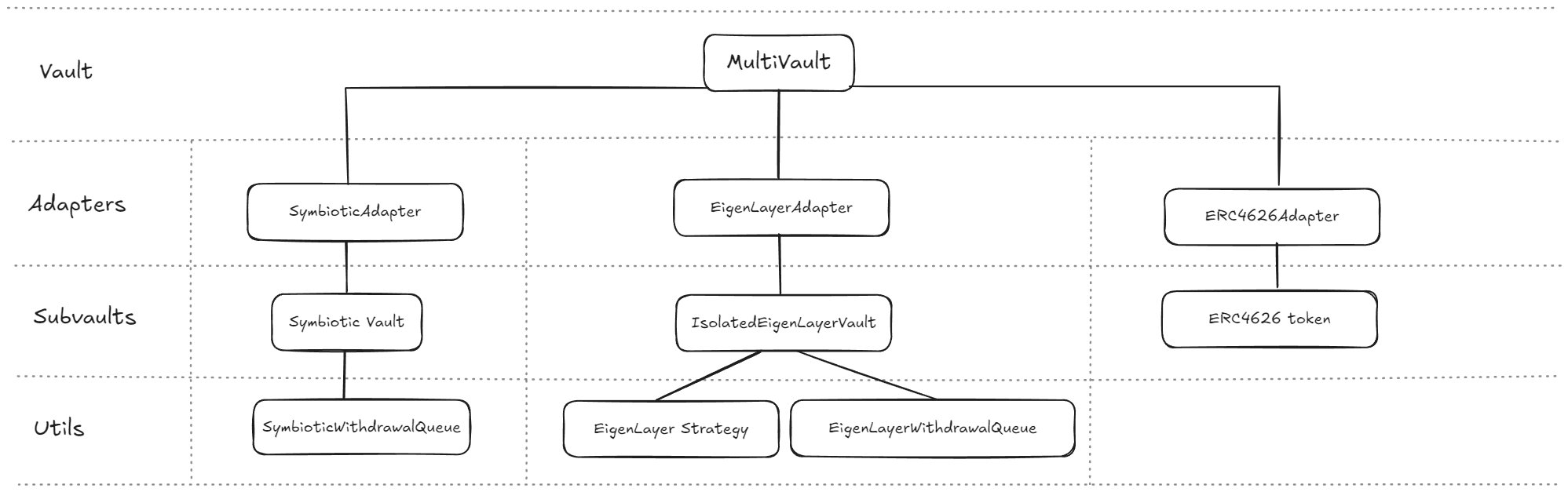
Key Characteristics
- The MultiVault operates with a single specified asset, which is allocated across a set of subvaults.
- Subvaults leverage different protocols to maximize efficiency and abstraction in managing restaking and yield generation.
Protocol Support
To interact with restaking protocols like Symbiotic and EigenLayer, the following adapters are implemented:- SymbioticAdapter
- EigenLayerAdapter
- EigenLayerWstETHAdapter
Withdrawal Queues
The system includes dedicated withdrawal queue implementations for managing protocol-specific withdrawal processes:- SymbioticWithdrawalQueue
- EigenLayerWithdrawalQueue
MultiVault Operations
Subvault Types
Each MultiVault operates a collection of subvaults, currently supporting three types:- SYMBIOTIC
- EIGEN_LAYER
- ERC4626
Asset Management Strategy
The RatiosStrategy is the core strategy contract, governing the distribution of assets between subvaults during deposits, withdrawals, and rebalances. It uses two parameters:- minRatioD18: Minimum ratio of assets allocated to a subvault.
- maxRatioD18: Maximum ratio of assets allocated to a subvault.
minAssets = multiVault.totalAssets() * subvaultRatios.minRatioD18 / 1e18maxAssets = multiVault.totalAssets() * subvaultRatios.maxRatioD18 / 1e18
Detailed Operations
Deposits
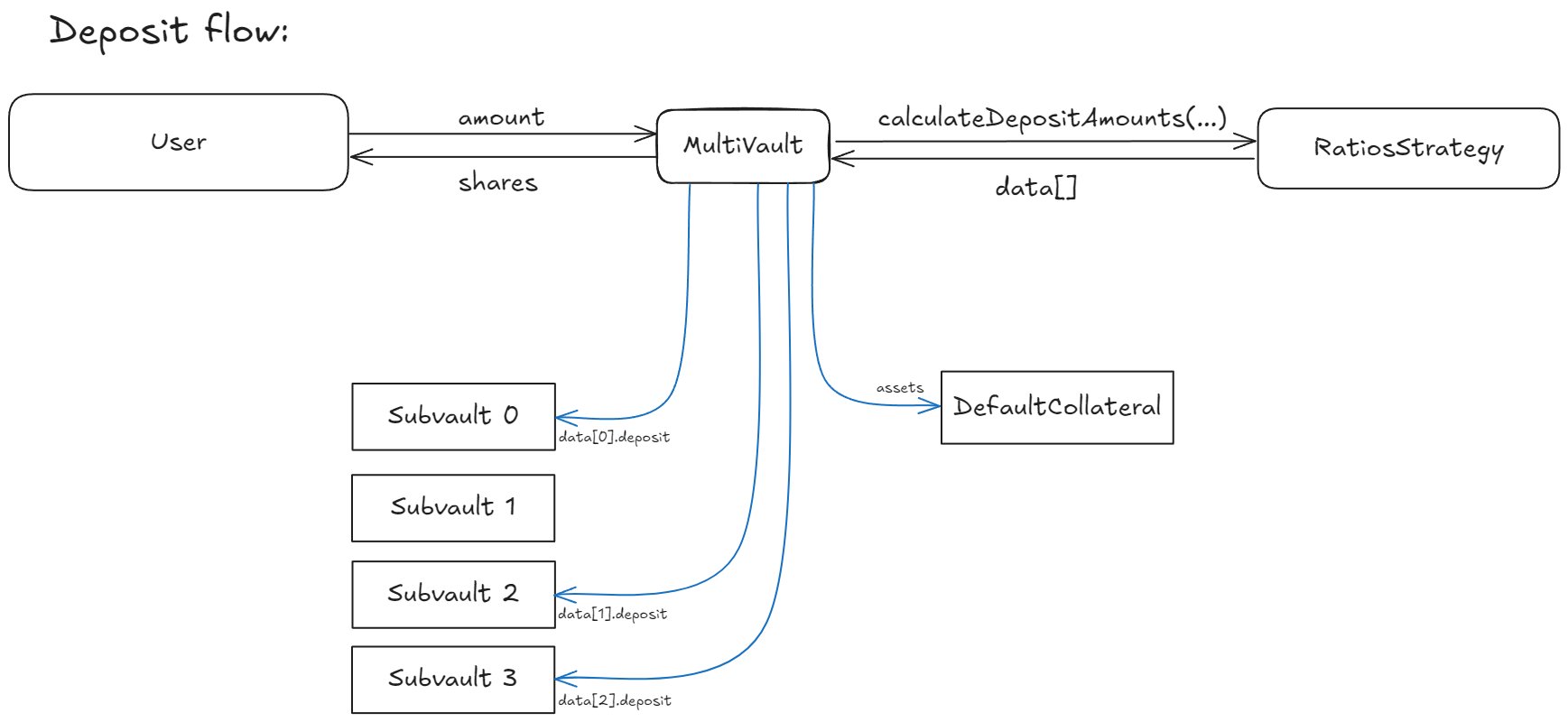
- Subvaults are filled to ensure staked assets ≥ min assets.
- Remaining tokens are distributed to ensure staked assets ≤ max assets.
- staked assets < min assets
- staked assets < max assets
Withdrawals
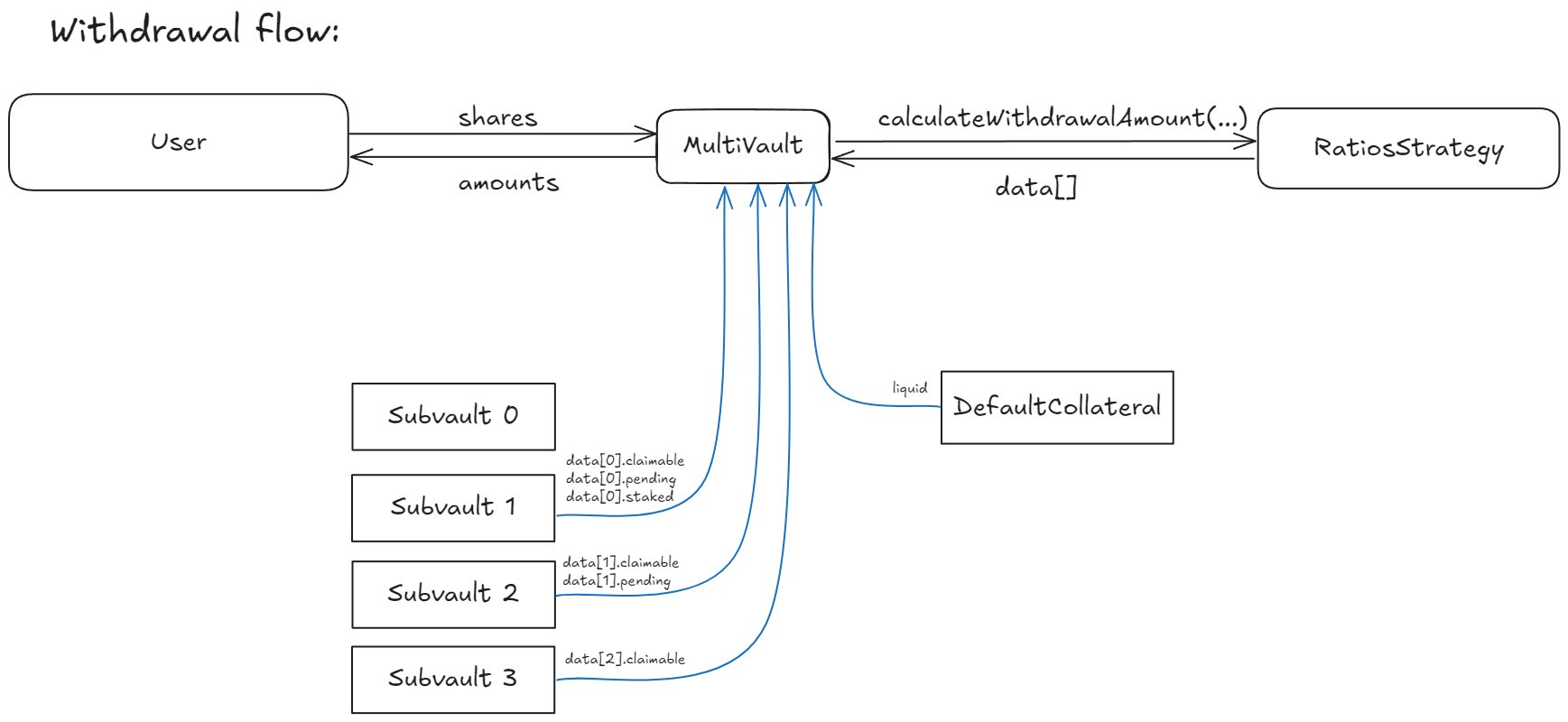
- Withdraw assets where staked assets > max assets.
- Withdraw assets to ensure staked assets ≥ min assets.
- Retrieve pending assets.
- Withdraw claimable assets.
- Withdraw remaining assets (0 < staked assets ≤ min assets).
- staked assets > max assets (Standard protocol withdrawal duration.)
- staked assets > min assets (Standard protocol withdrawal duration.)
- pending assets > 0 (Standard or shorter protocol withdrawal duration.)
- claimable assets > 0 (Instant withdrawal.)
- staked assets > 0 (Used only in exceptional cases to avoid strategy violations; standard protocol withdrawal duration.)
Rebalances
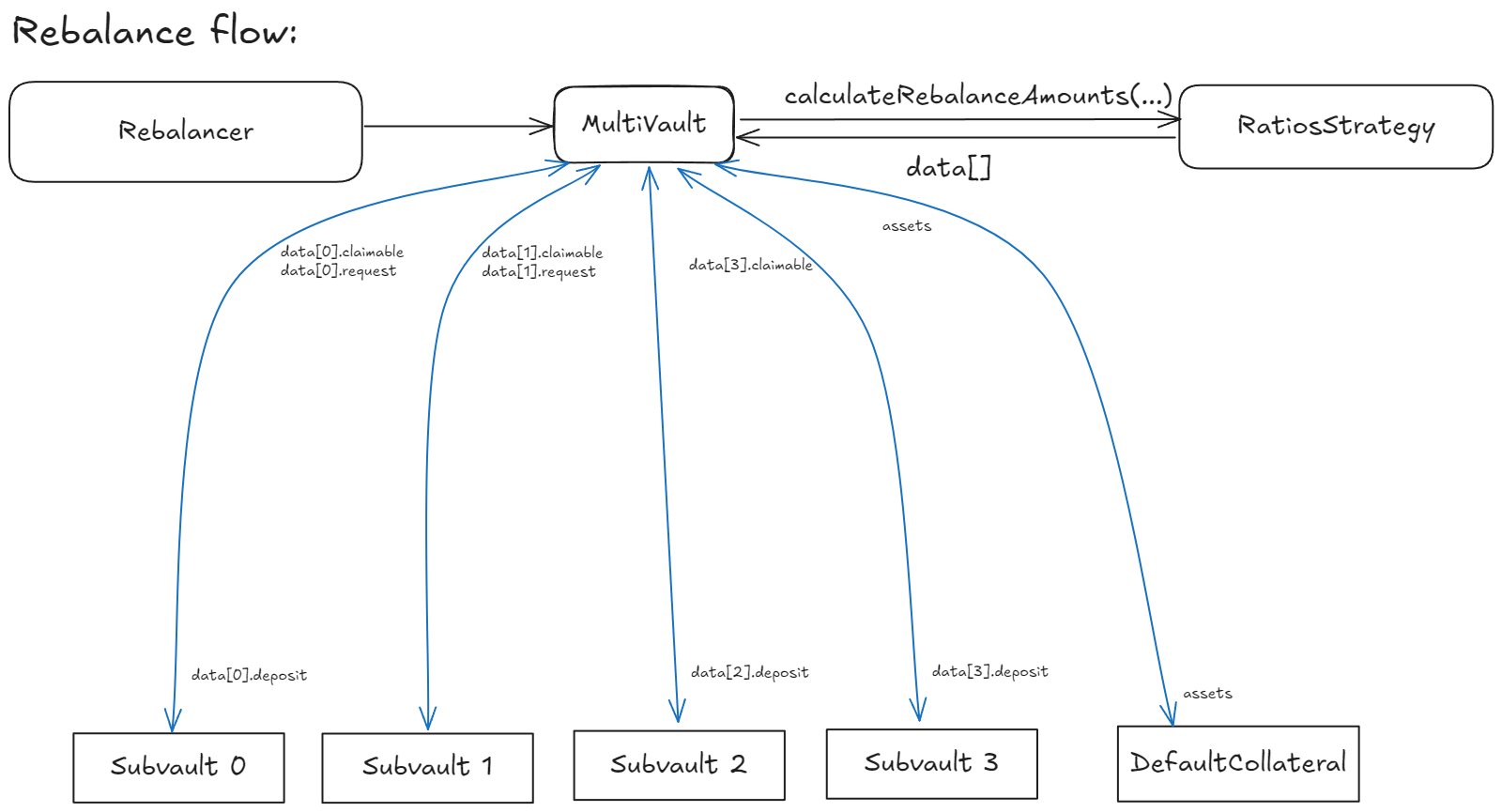
- Initial Withdrawals: Tokens are withdrawn from all subvaults where staked assets > max assets, as well as all claimable assets. At the same time, the total shortfall of assets in subvaults required to meet the min ratios (i.e., where staked assets < min assets) is calculated. This value is referred to as totalRequired.
-
Fulfilling Shortfall: If totalRequired is less than the sum of liquid and pending assets, tokens are withdrawn from subvaults to ensure staked assets > min assets.
All liquid assets, calculated as the sum of:
- claimable assets
- assets.balanceOf(multiVault)
- defaultCollateral.balanceOf(multiVault)
- Meeting Minimum Ratios: Tokens are deposited into subvaults to ensure staked assets ≥ min assets.
- Fulfilling Maximum Ratios: Remaining tokens are deposited into subvaults to ensure staked assets ≤ max assets.
- withdraw: claimable assets > 0, staked assets > max assets
- withdraw staked assets > min assets && total required assets > pending assets + liquid assets
- deposit: staked assets < min assets && liquid assets > 0
- deposit: staked assets < max assets
Protocol Integrations
Symbiotic Integration
The SymbioticAdapter is the main contract for interacting with the Symbiotic protocol. It handles:- Token accounting and limits.
- Interaction with standard reward farms.
- Deposits and withdrawals.
EigenLayer Integration
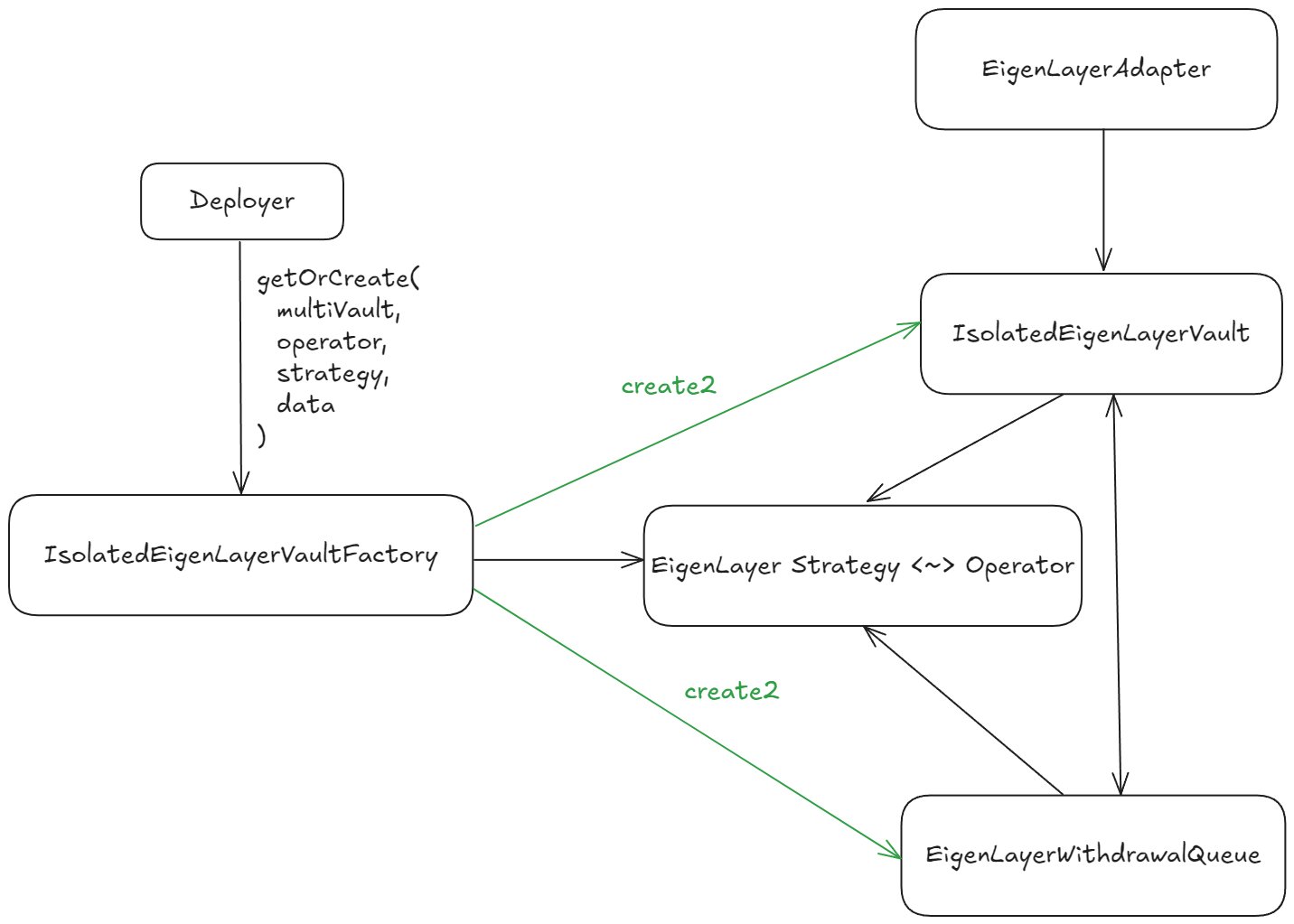
-
Pending Withdrawal Management:
Each withdrawal request in EigenLayer requires manual handling and adherence to the protocol’s delay. The queue ensures that:
- Pending requests are processed sequentially.
- Users cannot exceed the predefined limit of pending requests, preventing congestion.
-
Batch Claiming:
- The queue allows batch claiming of completed withdrawal requests, but only up to a specified maximum per call. This feature balances protocol interaction efficiency and security, preventing abuse or OOG.
-
User-Focused Optimization:
- Withdrawal requests are tracked per user, ensuring fairness and enabling claim prioritization based on request order.
Handling of wstETH and stETH
Since EigenLayer strategies utilize stETH (a rebasing token), a wstETH ↔ stETH conversion layer has been implemented to enable compatibility within the Symbiotic protocol. The use of wstETH ensures the following:- Unlike stETH, which periodically adjusts balances through rebasing, wstETH represents a wrapped, non-rebasing version of stETH, making it more stable for vault operations.
- MultiVaults leveraging EigenLayer strategies operate with wstETH, while the conversion layer handles the rebase adjustments internally, maintaining protocol compatibility.
IsolatedEigenLayerVault
A significant challenge in EigenLayer is the operator limitation, which restricts the number of operators an address can interact with. To address this, IsolatedEigenLayerVaults were developed:- Operator-Strategy Pairing:
- Each isolated vault is linked to a specific (strategy, operator) pair. This decoupling ensures scalability by avoiding operator limitations for a single address.
- Factory-Based Creation:
- Isolated vaults are created using dedicated factory contracts, such as:
- IsolatedEigenLayerVault
- IsolatedEigenLayerWstETHVault
- Isolated vaults are created using dedicated factory contracts, such as:
- Adapter-Driven Operations:
- The EigenLayerAdapter interacts with these isolated vaults instead of directly managing EigenLayer strategies. This abstraction simplifies MultiVault operations while ensuring protocol compliance.
- Validation on Addition:
- When an EIGEN_LAYER-type subvault is added to a MultiVault, the system verifies that the corresponding isolated vault was created through the appropriate factory contract. This validation step ensures consistency and security across all interactions.