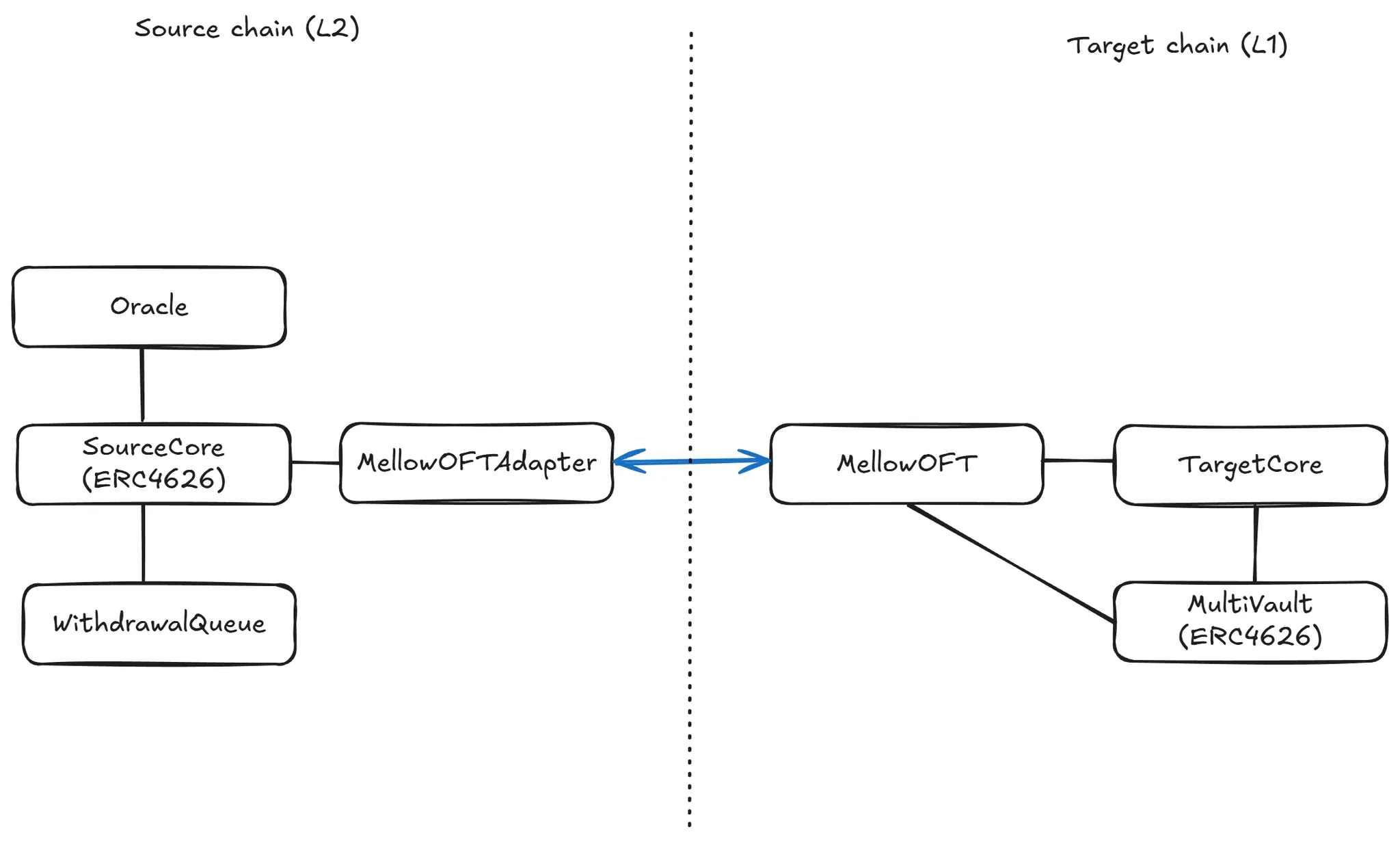
Legacy architecture. Interoperable Vaults is an earlier generation of Mellow vault infrastructure, documented for existing deployments. Core Vaults are Mellow’s current vault architecture.
Overview
This vault type is designed to allow users to delegate stake without direct liquidity transfers across various Layer 2 (source chain) networks to Layer 1 (target chain) with a following steps happening under the hood:- A user on an L2 deposits an asset into the vault.
- The user receives a corresponding receipt token on L2.
- The deposited liquidity is locked in the vault on L2.
- An OFT ( LayerZero Omnichain Fungible Token Standard) counterpart is minted on the target chain - Ethereum mainnet, where Mellow restaking vaults are deployed.
- That OFT is then used as the restaking asset within Symbiotic/EigenLayer vaults to provide shared security. Symbiotic has already whitelisted the OFT to have the same rewards rate as native L1 assets.
- The user earns rewards in two ways: first, through L2 incentives - some of the vault’s accumulated liquidity is staked directly, and some is used in DeFi strategies on the L2 via the receipt tokens; second, through direct restaking rewards (both tokens and points) from various networks.
- Source Chain (L2): Users deposit their assets and receive vault shares on L2.
- Target Chain (L1): Stake delegation occurs here after cross-chain transfer. The delegated stake is distributed among various yield protocols supported by Mellow MultiVault.
OFTAdapter can only be made via SourceCore.
Gas parameters are defined using enforced options in the OFTs.